Textile Guide Kitchen Linens
A Practical Guide to Absorbency and Drying in Kitchen Linens
A great kitchen towel does two jobs well: it takes up water when you need it to, then dries out before the next spill, stack of dishes or hurried hand-dry. Fabric, weave and everyday care all shape that balance. Here’s how to read the clues and choose kitchen linens that suit the way you actually cook.
Kitchen towels are humble household multitaskers. One minute they’re drying washed greens; the next, wiping a counter, catching a splash or polishing a glass. That variety makes their performance more complicated than a single promise of “high absorbency” suggests. A towel that soaks up a large spill may stay damp for hours. A lightweight cloth that dries quickly might need more passes to handle a wet pan.
The most useful kitchen linens balance three things: how much moisture the fabric can take up, how quickly it releases that moisture into the air, and how well the towel holds up to frequent washing. No one construction is ideal for every task. The practical solution is to understand the trade-offs, then choose a small rotation of towels for different jobs.
Absorbency and drying time are related—but not identical
Absorbency describes a fabric’s ability to take in and hold liquid. Drying time describes how quickly the moisture it has taken up can evaporate. They influence one another, but they are not the same measure. A towel may absorb a generous amount and still dry slowly if its fabric is dense, its pile is deep or the room has little airflow.
Think of a freshly washed plate and a damp countertop. For the plate, a smooth towel that leaves little lint and dries promptly between dishes may be the star. For the counter, a more substantial, absorbent cloth may be handy. For hands, a towel that hangs open and gets used repeatedly needs to release moisture efficiently, not just feel soft at first touch.
Performance is shaped by several factors working together: fiber type, yarn structure, fabric weight, weave, finishing treatments and the conditions in which the towel is used. Even the best-made kitchen towel can seem slow to dry when it is bunched on a hook, packed into a crowded laundry load or left in a humid corner.
Start with the fiber
Cotton is a familiar choice for kitchen towels because it absorbs water well, feels comfortable in the hand and is widely suited to regular laundering. But “cotton” alone does not tell you exactly how a towel will perform. Fiber length, yarn quality and construction influence the final fabric. A tightly woven cotton tea towel and a thick cotton terry cloth may behave very differently despite sharing the same basic material.
Linen, made from flax, is often valued for its crisp hand and ability to release moisture relatively readily. It can be useful for glassware and light drying tasks, and it tends to feel different from soft, fluffy cotton. A new linen towel may feel firm; repeated washing and use can change its character. Its performance still depends on the fabric’s weight and weave, so the fiber name is a helpful starting point, not a guarantee.
Blends combine fibers in different proportions to balance feel, durability or care. Read the stated composition rather than assuming a blend has one predictable advantage. Ask what the cloth is meant to do, and check the laundering instructions. For food-contact tasks, use clean towels and follow safe kitchen hygiene practices regardless of fiber content.
Labels may also highlight organic certification or a country of origin. Those details can help readers understand sourcing and production claims, but they do not, by themselves, establish that a towel will absorb faster or dry sooner. Construction and routine matter just as much.
Read the weave: flat, textured or terry
Flat-woven towels have no deep, upright loops. Depending on their yarn and weave, they can feel compact, light and easy to fold. Their relatively open structure may allow air to move through the fabric, helping a towel dry between uses. They are often convenient when storage space is limited or when you want a cloth that can be spread out quickly on a rack.
Flat-woven does not automatically mean quick-drying. A tightly constructed or heavier cloth can retain moisture, while a light fabric can be less suited to absorbing a large amount of water in one pass. Pay attention to the full construction and how it feels when damp, not just the category name.
Textured weaves introduce raised channels, ridges or other surface variation. The texture can increase the fabric’s contact with dishes and hands, while the spaces between raised sections may help air circulate. The effect depends on the design: texture is a useful clue, but not a substitute for checking weight and care details.
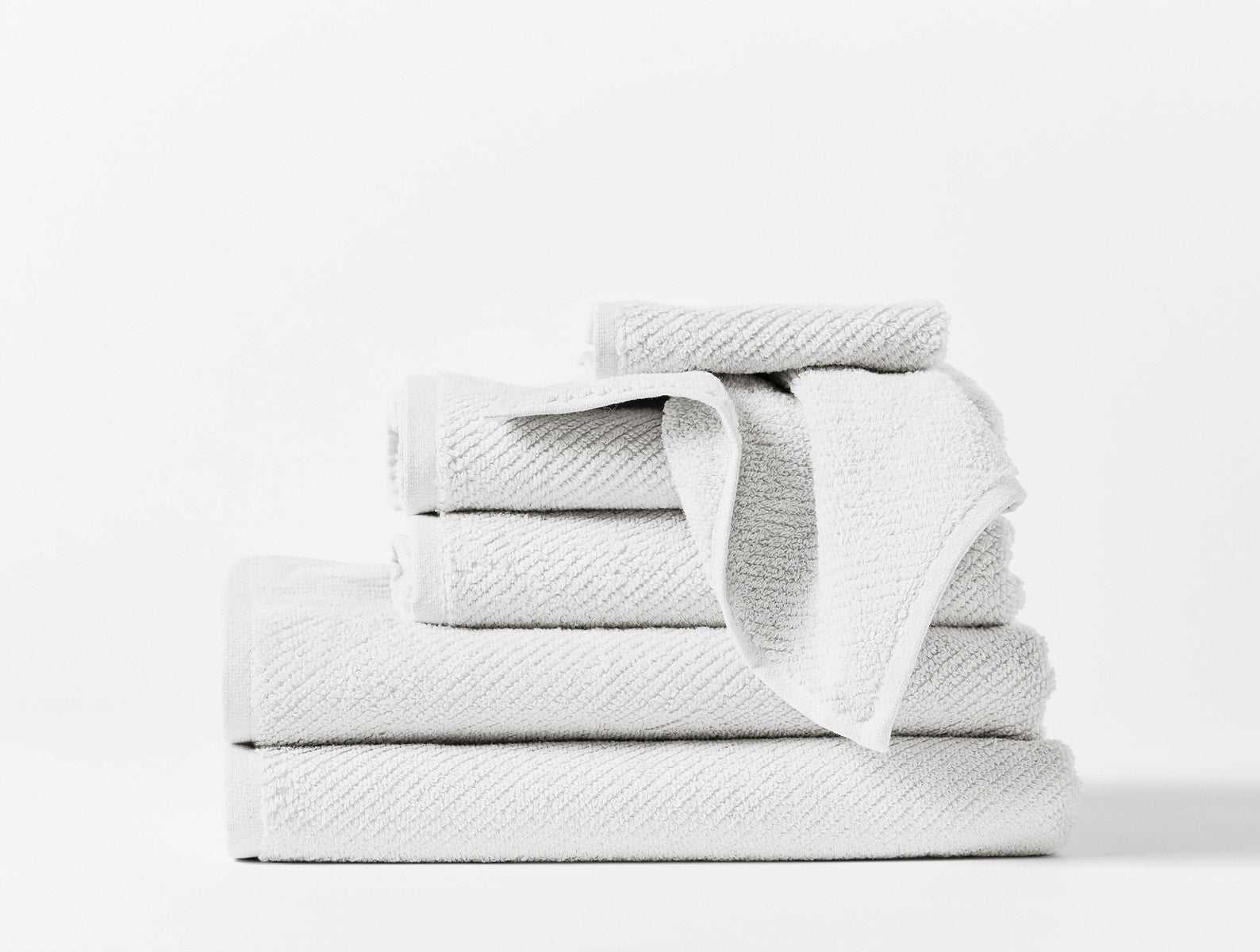
Terry towels use loops that create a larger surface area for taking up moisture. This makes terry a familiar choice for absorbent cloths and hand towels. More pile can also mean more fabric holding water, so a plush towel may take longer to dry than a lighter, flatter one. In a busy kitchen, that difference becomes noticeable when the towel is in near-constant rotation.
For many households, a mix makes more sense than choosing one weave for everything: flat or textured towels for glassware and general drying, and a more absorbent cloth for hands or heavier spills. Keep separate towels for tasks that should not be mixed, such as drying hands and wiping food-preparation surfaces.
What GSM can—and cannot—tell you
GSM stands for grams per square metre. It is a measure of fabric weight, not a direct rating of absorbency, softness or quality. In broad terms, a higher GSM means more mass in a given area, which may be associated with a denser or heavier cloth. That can feel substantial and may provide useful capacity, but it can also mean more time needed to dry.
A lower-GSM towel may feel lighter and take up less room, and some lightweight constructions dry quickly because they contain less material and can be spread out easily. But weight alone will not tell you how it handles a splash. Fiber, yarn, weave and finishing all contribute. Two towels with the same GSM can feel and perform quite differently.
Use GSM as one comparison point when specifications are available. Pair it with questions such as: Is the towel flat-woven or looped? What is the fiber content? Is it designed for wiping, drying dishes or handling hands? What does the care label recommend? The answers provide a more useful picture than a number on its own.
- For quick turnover: look for a lighter or more open construction that can hang fully extended.
- For wetter tasks: consider a towel with enough substance and surface area to take up moisture comfortably.
- For glassware: favor a smooth, low-lint surface and follow the maker’s care guidance.
- For frequent handling: check seam finishing and laundering instructions, not just initial softness.
How to judge a towel before buying
Product descriptions can be full of appealing adjectives, but a few concrete details are more useful. Look for the fiber composition, weave or construction, approximate weight if provided, dimensions and care instructions. These details help you compare like with like and anticipate how the towel will fit into your routine.
Consider the size in relation to the job. A generous cloth gives you room to dry larger dishes or cover a surface, but it needs enough space on a rail to air out. A smaller towel can be easier to swap frequently or place near a sink. The number of towels in rotation matters, too: having clean spares available reduces the temptation to keep using a cloth that is already damp.
Inspect the edges and seams where possible. Neat hems and secure finishing can help a towel withstand repeated washing, though no finishing detail guarantees a particular lifespan. If you are shopping online, detailed specifications and straightforward care directions are more informative than broad claims about luxury or performance.
Finally, be realistic about the room. A towel used in a small, humid kitchen with limited ventilation may dry more slowly than the same towel hung in an airy space. If dampness is a recurring problem, a lighter construction and a better place to hang it may make a bigger difference than buying a towel marketed as extra absorbent.
A simple setup for a busy kitchen
Instead of asking one towel to do every job, create a practical rotation. Keep a clean, dry towel ready for dishes; use a separate cloth for hands; and have an appropriate washable cloth for wiping work surfaces. This makes it easier to replace a damp towel promptly and helps prevent kitchen tasks from blurring together.
For dish drying, choose a cloth with a smooth or lightly textured surface that feels comfortable when it is damp. For hands, prioritize a towel that can hang open near the sink and be changed often. For spills, a more absorbent construction may be useful, but it should go straight into the laundry if it has picked up food residue or other contamination.
Hang towels so air can reach both sides. A crowded hook or a towel folded into a thick bundle traps moisture. If your kitchen has a rail, spread the cloth out rather than layering it over another damp towel. That small habit can improve drying time without changing the fabric at all.
Care habits that preserve performance
Frequent washing is part of kitchen linen care, but heavy residue can make fabric feel less absorbent. Follow the care label, use an appropriate amount of detergent and avoid overloading the washer. When towels are packed too tightly, water and detergent may not circulate as effectively, and rinsing can be less thorough.
Fabric softener may leave a coating on some textiles that changes how readily water moves into the fibers. If a towel seems to repel water or feels coated, try washing it according to its instructions without softener and reassess after it is completely dry. Do not assume every towel needs the same treatment: manufacturer guidance should take priority, especially for blends or specialty finishes.
Drying conditions count. Remove towels promptly from the washer, shake them out and hang them with room around them, or use a dryer setting appropriate to the care label. Leaving wet laundry in a closed machine can encourage stale odours. Between uses, never leave a damp kitchen towel in a heap on the counter.
Keep kitchen towels separate from items that may transfer grease, lint or strong odours, and wash them as often as their use requires. A towel used for raw food spills should be handled with appropriate food-safety care and laundered promptly. Clean towels are not just more pleasant; they make the whole system work better.
Common kitchen-towel myths
“Heavier always means more absorbent.” Weight can suggest a substantial fabric, but it cannot reveal how the fibers, yarn and weave interact with water. A dense towel may feel reassuring yet take longer to dry. Compare construction as well as GSM.
“Quick-drying means it cannot absorb much.” Drying speed and absorbency are separate performance questions. A thoughtfully constructed towel can be useful at both, although there are trade-offs and no fabric can defy its conditions. How it is hung and how humid the room is also matter.
“Softness proves quality.” A soft hand can be appealing, but finishes or softeners may affect the way a textile handles water. Initial feel does not tell the whole story. Consider the towel after laundering and look for clear information about its construction.
“One towel type is best for every kitchen.” Cooking habits, laundry schedules, available hanging space and preferred textures all vary. A compact towel that suits a small household may not be the best choice for a kitchen where several people cook throughout the day.
The bottom line: choose for your routine
The right kitchen linens are not necessarily the thickest, softest or most expensive. They are the ones that do the jobs you need, dry reliably in your space and tolerate the washing routine you can maintain. Fiber tells you what the fabric is made from; weave hints at how its surface is built; weight offers context; and care instructions help set expectations for everyday use.
If you are uncertain, begin with a modest mix: a smooth towel for glassware, a textured or flat-woven option for general drying, and an absorbent cloth for hands or spills. Use each for its intended task, hang it open after use and keep clean replacements on hand. Then pay attention to what happens in your own kitchen. That everyday test—how a towel feels damp, how it handles a spill, and how soon it is ready again—is ultimately more useful than a grand claim on a label.
Quick checklist for choosing kitchen towels
- Check fiber content and fabric construction rather than relying on a broad product description.
- Use GSM as a comparison detail, not as a stand-alone score for quality or absorbency.
- Think about the job: drying dishes, wiping hands and cleaning spills may call for different cloths.
- Choose a size that is easy to use and can be hung fully open in your kitchen.
- Read the care label and consider how often you can wash and replace the towels.
- Keep towels separate by task, and launder them promptly when they become damp or soiled.
Frequently asked questions
What makes a kitchen towel absorbent?
Absorbency depends on the fiber, yarn, weave and any finishes on the fabric. Cotton is commonly used for absorbent kitchen towels, while terry loops and other textured constructions can provide more surface area. The specific design matters more than one label term alone.
Do flat-woven kitchen towels dry faster?
They can, particularly when the fabric is light and can be spread out to expose it to airflow. But flat-woven towels vary in density and weight, so the construction and drying conditions still matter.
Does a higher GSM mean a better towel?
No. GSM measures weight per area, not overall quality. A heavier fabric may feel substantial and hold more moisture, but it may also need longer to dry. Choose according to the task and your kitchen’s laundering and drying routine.
How can I help a damp kitchen towel dry more quickly?
Hang it fully open, avoid stacking it with other damp cloths and choose a spot with airflow. Remove wet towels from the washing machine promptly, and follow the care label when laundering and drying them.